
For most commercial facilities across the Atlanta Metro area and the Florida Panhandle, the season is either closed or winding down, and attention has already shifted to winterization, storm cleanup, and 2027 budget planning. But before those service records get filed away, they’re worth a closer look. A season’s worth of chemical logs, water usage, repair tickets, and complaints holds more information than any single closing inspection ever could — if someone actually reviews it as a whole.
This is where a commercial pool post-season assessment comes in, and it’s the focus of this guide: how to review 2026’s service records for patterns that a single site visit would miss, what those patterns typically reveal about leaks, equipment, and maintenance quality, and how to turn those findings into a 2027 capital budget that’s built on documented data instead of guesswork. Specialty Aquatics and Consulting works through this process every fall with the HOAs, hotels, municipalities, and multi-family properties it serves across both regions.
What Is a Commercial Pool Post-Season Assessment?
A post-season assessment is a documented review of everything that happened at a facility over the course of the swim season, evaluated together rather than in isolation. It’s different from a closing inspection, which checks the pool’s condition at a single point in time, and different from routine maintenance visits, which address issues as they come up. The assessment looks backward across the whole season to answer a harder question: what do these records, taken together, tell us that no single visit would have shown?
The stakes here are higher than they might seem. According to the CDC’s Model Aquatic Health Code program, roughly one in eight routine public pool inspections ends in an immediate closure because of a violation serious enough to threaten public health. A thorough post-season review is one of the more effective ways for a facility to catch the kind of developing issue that leads to that outcome before an inspector does.
For HOAs, hotels, municipalities, and property managers, a pool can pass every individual service visit and still be masking a developing leak, a pump nearing failure, or a chemical feed system that’s been overcorrecting all summer. Those patterns only surface when someone reviews the full record.
When Should a Commercial Pool Post-Season Assessment Be Completed?
Timing depends on how the facility’s season actually runs, not a fixed calendar date.
For seasonal commercial pools in the Atlanta Metro area, the weeks right after closing are the ideal window — the same stretch covered in our Labor Day winterization guide. Staff turnover hasn’t happened yet, service technicians still remember specific incidents, and the season’s records are complete rather than scattered across memory and paperwork months later. Because Atlanta pools work toward a water-temperature-driven closing rather than staying open indefinitely — typically landing in late September or early October — the assessment can happen as a single, concentrated review once that closing takes place, right alongside winterization.
In the Florida Panhandle, many commercial and resort pools stay open later, operate through the shoulder season, or run year-round. A single annual review doesn’t fit that operating pattern as well. Panhandle facilities generally get more value from a rolling assessment — reviewing records quarterly as part of ongoing Florida Panhandle commercial pool maintenance peak summer demand and hurricane season activity begin to ease — rather than waiting for one closing date that may not exist.
Which Pool Service Records Should Property Managers Review?
A complete assessment pulls from several sources, not just the maintenance company’s visit notes:
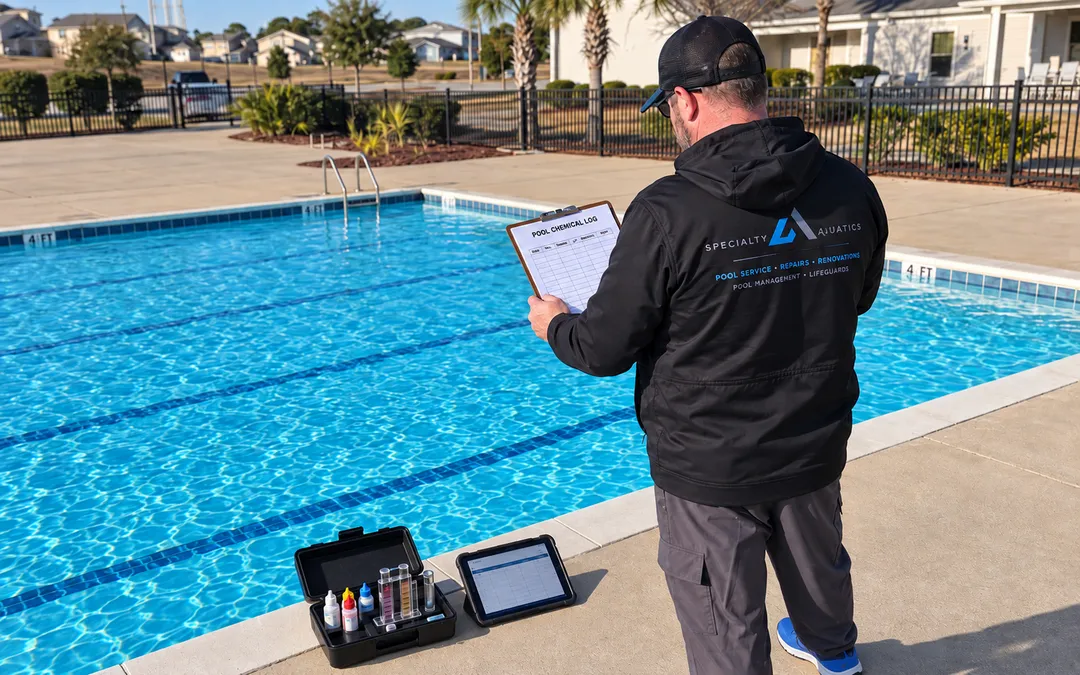
Chemical logs — pH, free chlorine, alkalinity, and stabilizer readings across the season, not just the most recent numbers
Water usage and make-up water records — from the water utility bill or sub-meter, if the facility has one
Repair and service tickets — every call, not just the major ones
Equipment run-time and cycle data, especially from any automation or remote monitoring system
Guest or resident complaints — cloudy water, odor, temperature, closures
Closure records — how often, how long, and why the pool was shut down
Staffing and lifeguard coverage notes, where relevant to compliance
Most facilities have all of this information somewhere. Few facilities have ever looked at it together in one place.
What Your Records Can Actually Reveal
Reviewed individually, these records look like routine paperwork. Reviewed as a set, they start to answer questions no single visit can.
Repeated chemical corrections. If a pool needed the same correction — a chlorine bump, a pH adjustment — over and over throughout the season, that’s rarely a one-time fluke. It usually points to something structural: an undersized feed system, a sensor drifting out of calibration, unusually high bather load relative to the pool’s turnover rate, or a leak diluting chemical concentration faster than expected.
Water loss patterns. Every pool loses some water to evaporation and splash-out, and that amount is fairly predictable for a given size, climate, and usage level. When water usage climbs above that baseline and doesn’t track with weather or attendance, a leak is the most common explanation — and it’s often invisible to the eye long before it’s visible in a drained skimmer or a cracked deck.
Equipment performance drift. A pump running longer to move the same volume of water, a heater cycling more frequently, or a filter needing more frequent backwashing than it did the previous season are all early signs of equipment nearing the end of its useful life — well before it fails outright.
How Do You Decide Whether to Repair, Replace, or Continue Monitoring?
Not every finding calls for the same response, and treating every yellow flag as an emergency repair wastes budget just as surely as ignoring a real one wastes it. A useful way to sort findings:
Continue monitoring — an isolated incident with no repeat pattern and no safety implication
Repair now, before next season — a confirmed issue (a documented leak, a failing sensor) where the cost of waiting exceeds the cost of fixing it
Replace, don’t repair — equipment that’s required multiple repairs in the same season, is out of warranty, or is showing performance drift consistent with end-of-life failure. Our commercial pool equipment specification guide covers what to look for when it’s time to spec a replacement rather than patch what’s there
Flag for the capital budget — larger items (resurfacing, major equipment, automation upgrades) that aren’t urgent but should be scoped and priced while contractor calendars still have room
The service records are what move an item from “gut feeling” to a documented case for the board or ownership group.
How Remote Monitoring Can Improve Post-Season Planning
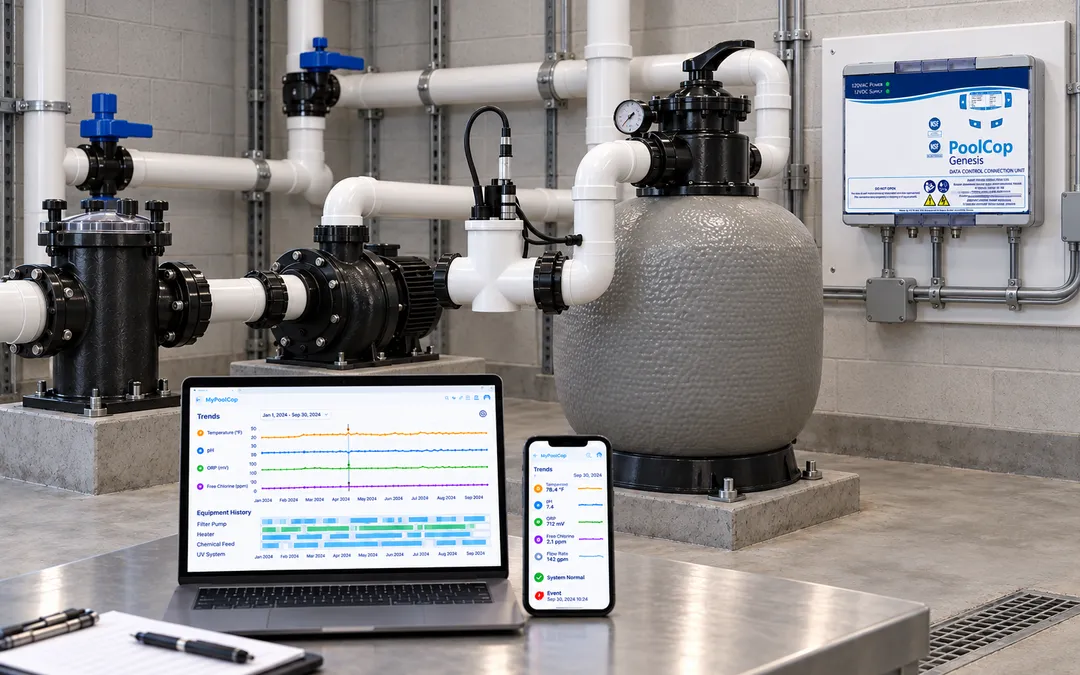
Facilities with a remote monitoring system in place — PoolCop is a common example in this market — have a real advantage here, because the data is already continuous and time-stamped rather than reconstructed from memory or scattered paper logs. Instead of relying on a technician’s recollection of “the pump seemed off in July,” remote monitoring can show exactly when chemical readings started drifting, how often the equipment cycled, and whether a correction actually held or had to be repeated. That turns the post-season assessment from an exercise in reconstructing the season into a much faster review of data that was being collected the whole time.
What Findings Should Be Included in Next Year’s Pool Budget?
Winterization season and budget season overlap for most facilities, which makes the post-season assessment a natural input into fall 2027 budget planning — not a duplicate of it. The assessment’s job is to supply the specifics: which equipment showed measurable performance decline, which repairs recurred often enough to justify replacement rather than another patch, whether water-loss data supports a leak-detection investigation, and which capital items (resurfacing, automation upgrades, safety cover replacement) are worth scoping now while contractor schedules and material lead times are still manageable. A budget built on a season of documented data holds up far better in front of a board than one built on impressions.
Who Should Perform an Independent Commercial Pool Assessment?
This is worth sitting with for a moment, because there’s a real conflict of interest hiding in plain sight: if the same company that performed your season’s maintenance and repairs is also the one assessing whether that work was effective, the incentive to find fault with their own service is weak at best.
That doesn’t mean an in-house or contracted maintenance provider can’t do a competent closing inspection — many can. But an independent pool safety audit, performed by a commercial pool consulting firm with no stake in the coming season’s repair or service contract, is better positioned to tell a board or property manager an uncomfortable truth: that a recurring chemical issue was a symptom of poor technique, that a piece of equipment was patched three times when it should have been replaced after the first failure, or that a leak went undiagnosed for months. For HOAs and municipalities in particular, where board members are accountable to residents or taxpayers for how maintenance dollars are spent, that independence has real value beyond the assessment itself.
The Bottom Line
A commercial pool’s service records hold more information than most facilities ever use. Reviewed as a season-long pattern rather than a series of disconnected visits, they can reveal leaks, failing equipment, and process problems well before they become expensive spring surprises — and they give property managers and boards the documented case they need to budget accurately for 2027.
Contact Specialty Aquatics and Consulting to schedule a post-season assessment for your Atlanta or Florida Panhandle facility, or to discuss an independent review of your current maintenance provider’s season.
Frequently Asked Questions
1. Is there a best time of year to do a post-season pool assessment? For Atlanta-area seasonal pools, the weeks right after closing work best, while records and staff recollection are still fresh. Florida Panhandle facilities that stay open later or year-round generally get more value from reviewing records on a rolling basis, rather than waiting for one annual closing date.
2. What records does a facility actually need to pull together for this kind of review? Chemical logs, water usage or make-up water data, every repair ticket (not just the major ones), equipment run-time data if available, guest or resident complaints, and closure records. Most facilities already have all of this — it just hasn’t been reviewed as one connected set before.
3. How can I tell from pool records whether I might have a leak? Water usage that runs consistently higher than normal evaporation and splash-out for the pool’s size and climate is one of the more reliable signs, especially when it shows up alongside chemical readings that never quite stabilize despite regular corrections.
4. My maintenance company keeps repairing the same piece of equipment — should I replace it instead? Frequency is the tell. An isolated repair may be nothing more than routine wear, but equipment that’s needed multiple repairs in a single season, or that shows measurable performance decline over time, is usually a stronger candidate for replacement than for another patch.
5. Should the same company that maintains our pool also be the one assessing it? Not ideally. A provider evaluating its own season’s work has limited incentive to flag its own shortcomings. An independent assessment, from a consultant with no stake in the next service or repair contract, is better positioned to surface issues honestly — which matters most for HOA boards and municipalities accountable to residents or taxpayers for how maintenance dollars are spent.
6. How does Specialty Aquatics and Consulting help facilities with post-season assessments? The team at Specialty Aquatics and Consulting reviews a facility’s full season of chemical, equipment, and service records to identify patterns worth acting on before the next budget cycle, and can perform that review independently of whichever provider handled the season’s maintenance. Visit our services page for the full range of maintenance, consulting, and equipment solutions available to HOAs, hotels,